Complete Guide to Plastic Buckles in Outdoor Gear
Plastic buckles are more than simple fasteners. In backpacks, camping equipment, cycling bags, hydration systems, pet gear, and other outdoor products, they help secure webbing, adjust strap length, attach accessories, and support convenient opening and closing.
Selecting the right outdoor buckle requires more than matching its appearance. The buckle type, webbing width, resin, load requirement, operating temperature, UV exposure, and expected service life should all be evaluated as part of the complete product design.
Why Use Plastic Buckles for Outdoor Gear?
Outdoor equipment must balance weight, durability, usability, and environmental resistance. Plastic buckles are widely used because they can offer several practical advantages:
- Lightweight construction: Plastic hardware can reduce the overall weight of backpacks, apparel, and portable equipment.
- Corrosion resistance: Plastic does not rust, making it suitable for humid, rainy, or coastal environments.
- Design flexibility: Injection molding supports different shapes, sizes, functions, textures, and integrated features.
- Material options: POM, nylon, PP, and other resins can be selected according to strength, flexibility, temperature, and environmental requirements.
- Production efficiency: Once the mold is completed, injection molding can provide consistent quality for medium- and high-volume production.
Weather resistance varies by resin and grade. If a buckle will be exposed to prolonged sunlight, cold conditions, heat, moisture, chemicals, or repeated loading, the material should be selected and tested for the actual application.
Common Types of Outdoor Plastic Hardware
1. Side-Release Buckles
A side-release buckle consists of male and female components that snap together for quick fastening and release. Depending on the design, one or both sides may include an adjustment feature for controlling webbing length and tension. Common applications include backpacks, luggage, apparel, pet collars, life jackets, and camping equipment.
2. Tri-Glide Slides and Ladder Locks
Tri-glide slides and ladder locks are used to adjust webbing length and help maintain strap tension. They are commonly found on backpack shoulder straps, chest straps, pet harnesses, cycling bags, sleeping bags, and outdoor accessories. The correct threading method and buckle geometry are important for preventing unintended webbing slippage.
 B1 Plastic Slide
 B2 Toothed Tri-Glide
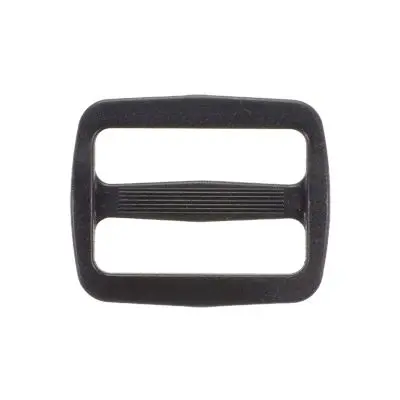 B3 Wide-Mouth Slide
 T1 Ladder Lock T2 Heavy-Duty Ladder Lock T8 Curved Ladder Lock
3. Plastic Rings and Loops
D-rings, O-rings, triangular rings, rectangular rings, and square loops provide attachment or routing points for webbing, straps, cords, and accessories. They are commonly used on backpacks, footwear, pet gear, tents, apparel, and other outdoor equipment.
4. Hydration Tube Clips
Hydration tube clips help guide and secure a drinking tube on a backpack shoulder strap or other accessible location. The tube diameter, clip opening, retention force, and attachment method should be checked with the complete hydration system.
5. Cord Hooks
Plastic cord hooks are designed for use with round cords, shock cords, or elastic ropes. They can connect, secure, or attach accessories in applications such as outdoor bags, camping equipment, rafting accessories, covers, and netting.
6. Heavy-Duty Buckles
Heavy-duty buckle designs may use reinforced structures, thicker frames, larger locking areas, or engineering resins to support higher load requirements. Glass-fiber-reinforced nylon may improve stiffness and tensile performance, but the resin grade and buckle design should be evaluated together because reinforcement can also affect impact behavior and flexibility.
For tactical equipment, large-dog gear, workwear, or high-load outdoor products, the finished buckle-and-webbing assembly should be tested under the intended loading and environmental conditions.
7. Cord Locks and Cord Stoppers
A cord lock uses a spring-loaded button or another locking structure to hold a cord in position. Pressing the button releases the cord so its length or tension can be adjusted; releasing the button locks it again. Single-hole and double-hole designs are available for drawcords used on apparel, sleeping bags, tents, backpacks, and other outdoor products.
How to Select the Right Buckle Material
No single plastic material is best for every outdoor application. Material selection should reflect the buckle design, load, temperature, exposure conditions, and required service life.
| Material | Typical Characteristics | Common Considerations |
|---|---|---|
| POM (Acetal) | Good stiffness, fatigue resistance, dimensional stability, and low moisture absorption | Often used for side-release buckles, slides, and functional snap-fit components |
| PA / Nylon | Good toughness, wear resistance, and impact performance; reinforced and special grades are available | Moisture absorption can affect dimensions and properties; grade selection is important |
| PP | Lightweight, chemical-resistant, and relatively flexible | Suitable for selected lower-load parts; strength and temperature requirements should be reviewed |
| TPU / TPE | Soft-touch, flexible, and suitable for grip or overmolded areas | Hardness, bonding compatibility, abrasion, and weathering requirements must be specified |
For prolonged outdoor exposure, consider UV-stabilized or weather-resistant grades rather than assuming that every standard resin provides the same protection. Cold-temperature impact performance and heat resistance should also be confirmed using the selected production material.
How to Choose the Right Plastic Buckle
Identify the buckle's function
Determine whether the component must fasten, release, adjust, retain, route, or attach. A side-release buckle, tri-glide slide, ladder lock, cord lock, and ring perform different functions and should not be selected by appearance alone.
Match the buckle to the webbing width and thickness
The buckle's inner opening should match the nominal webbing width, but webbing thickness, weave, stiffness, and surface texture also affect fit and slippage. Test the actual production webbing whenever possible.
Define the load and safety requirements
Specify the expected working load, peak load, pull direction, safety factor, and whether the buckle is used in a safety-related application. Tensile strength should be evaluated using the intended buckle, webbing, stitching, and product construction.
Review the operating environment
Consider UV exposure, humidity, salt water, temperature range, chemicals, dirt, repeated impact, and opening-and-closing frequency. These conditions influence both material selection and testing.
Confirm compliance and customization requirements
If the finished product is sold in regulated markets, confirm whether material documentation or testing such as REACH or RoHS is required. Custom colors, logos, resin grades, and packaging should also be defined before quotation and sampling.
Testing and Environmental Considerations
A buckle should be evaluated as part of the complete outdoor product rather than as an isolated component. Depending on the application, validation may include:
- Tensile or breaking-strength testing
- Opening-and-closing cycle testing
- Webbing slippage or adjustment testing
- Low- or high-temperature conditioning
- UV or weathering evaluation
- Impact, drop, or fatigue testing
- Salt water, moisture, or chemical exposure testing
Test methods and acceptance criteria should be based on the finished product's intended use. A strong buckle cannot compensate for unsuitable webbing, weak stitching, incorrect threading, or an inadequate product design.
Plastic Buckles for Outdoor Gear FAQs
Q1: What is the best plastic material for outdoor buckles?
POM is commonly selected for stiffness, dimensional stability, and fatigue resistance, while nylon may be considered when toughness, impact performance, or special reinforced grades are required. The best choice depends on the buckle design, load, temperature, moisture, UV exposure, and required service life.
Q2: How do I select the correct buckle size?
Start with the nominal webbing width and compare it with the buckle's inner opening. Webbing thickness and texture also matter, so the actual webbing and buckle should be assembled and tested before mass production.
Q3: Are all plastic buckles UV-resistant?
No. Outdoor durability varies by resin, color, additives, and exposure conditions. If prolonged sunlight exposure is expected, request a suitable UV-stabilized grade and define the required weathering test.
Q4: Can plastic buckles be customized?
Depending on the model and order quantity, customization may include resin selection, Pantone color matching, logo engraving, and application-specific testing. A completely new buckle shape generally requires a custom injection mold.
Q5: Do outdoor buckles need REACH or RoHS compliance?
The requirement depends on the destination market, product category, and customer's specification. If compliance documentation or testing is required, it should be confirmed before material selection and production.
Q6: Can buckle strength be judged by appearance or material alone?
No. Strength depends on the complete combination of buckle geometry, resin grade, molding quality, webbing, stitching, load direction, and environmental conditions. Testing the finished assembly provides more meaningful results than evaluating the buckle alone.
Discuss Your Outdoor Buckle Requirements
Plastic buckles and hardware can improve the functionality, weight, and usability of outdoor products when the correct design and material are selected. Ji-Horng Plastic Co., Ltd. manufactures plastic buckles, strap adjusters, rings, cord locks, hooks, and other injection-molded components for outdoor, safety, pet, and industrial applications.
For a more accurate product recommendation or quotation, please provide the required buckle type, webbing width and thickness, application, material preference, color, expected quantity, load requirement, and any environmental or compliance standards.
Contact us for product selection, customized buckle development, or plastic injection molding support.
Email: service@ji-horng.com.tw
Tel: +886-4-8355057
About the author: Ivan Shih